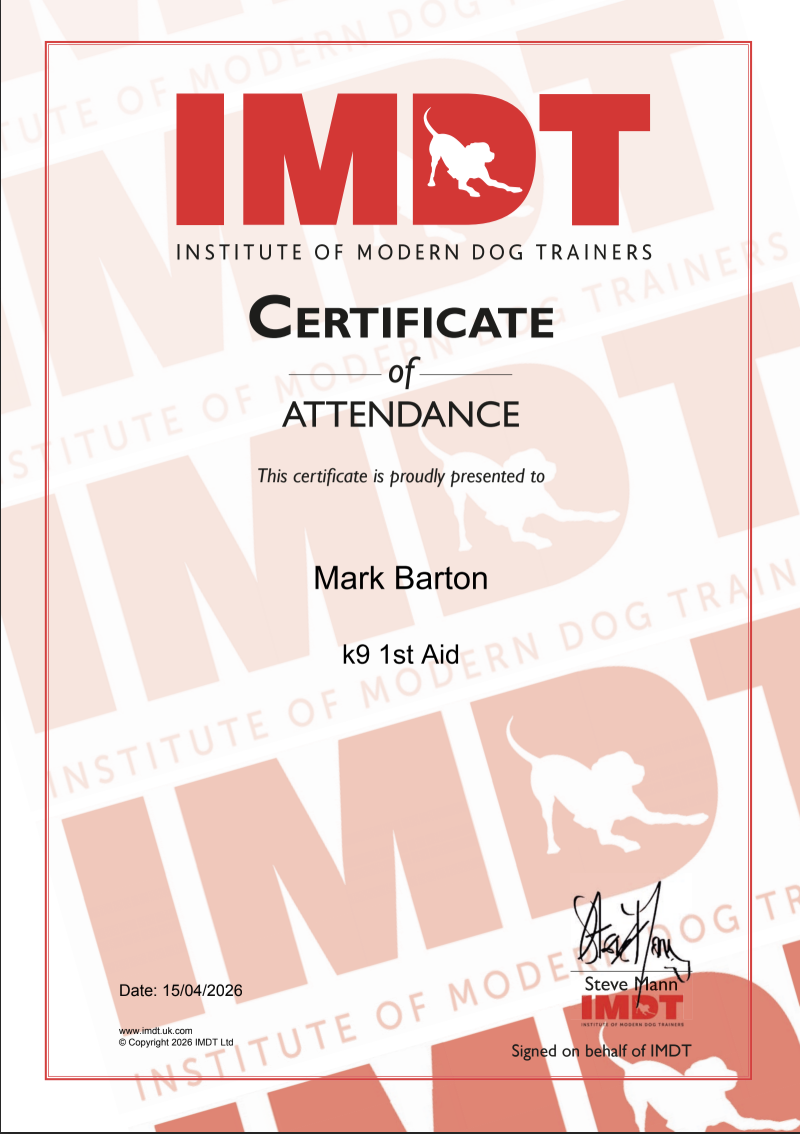
K9 First Aid
When you live with a dog, you quickly realise how much they rely on you. Not just for training and guidance, but for their safety too.
I’ve recently completed a K9 First Aid course with the Institute of Modern Dog Trainers as part of my ongoing professional development.
It’s something I believe strongly in. Not just learning these skills once, but keeping them up to date.
Because in an emergency, it’s not just about knowing what to do. It’s about being confident enough to act calmly and appropriately.
Why keeping first aid knowledge updated matters
Dog first aid is not something you learn once and forget.
Best practice evolves, and just like training methods, it’s important to stay current.
Regularly refreshing this knowledge helps ensure you are using the most appropriate and safe techniques, staying confident in high pressure situations, and able to support your dog or a client’s dog effectively until veterinary help is available.
For me, it’s part of a wider commitment to responsible, ethical and professional dog training.
Why K9 first aid matters for every owner
Dogs are naturally curious, energetic and often unpredictable.
That combination means accidents can and do happen. A cut paw on a walk, eating something they should not, overheating in warmer weather, or minor injuries during play.
K9 first aid is not about replacing a vet. It is about staying calm, knowing what to do in the moment, and preventing a situation from getting worse.
The most common situations I see
Working with dogs and owners across Richmond, Teddington and South West London, the most common issues tend to be minor cuts and grazes from pavements or parks, scavenging or ingesting unsuitable items, overheating during warmer days, and sudden limping or discomfort.
Often these situations are not dramatic, but knowing how to respond makes all the difference.
Simple first aid principles to follow
In any situation, your approach matters just as much as the action you take.
Stay calm. Your dog will feed off your energy.
Assess before acting. Take a moment to understand what is happening.
Keep your dog safe. Prevent further injury or stress.
Contact your vet when unsure. Always err on the side of caution.
A simple dog first aid kit
A basic kit at home, and ideally in your car, can make a big difference.
Include bandages and gauze, saline solution, pet safe antiseptic wipes, a tick remover, tweezers, a clean towel, and your vet’s contact details.
It does not need to be complicated. It just needs to be there when you need it.
Training and safety go hand in hand
Many emergency situations can actually be reduced through training.
A reliable recall can prevent dangerous encounters. A strong leave it can stop scavenging. Calm behaviour reduces risk in busy environments.
A well trained dog is not just easier to live with. They are often safer too.
Final thoughts
Completing K9 First Aid training with the Institute of Modern Dog Trainers is an important step, but keeping that knowledge fresh is just as important.
It is all part of making sure I can support both dogs and owners in a calm, practical and responsible way.
Because ultimately, it is about being prepared and doing the best you can when it matters.
A Final Thought
There’s a lot of conflicting advice out there when it comes to dog training.
For me, becoming qualified through the IMDT has helped shape a clear philosophy:
Keep things simple.
Keep things fair.
And focus on what works in real life.
Get in touch. You can learn more here: