Food dropped on a pavement can be more than inconvenient. It may be unsuitable, spoiled or dangerous, and a dog who reaches it quickly can leave an owner feeling they have no time to respond.
A “leave” cue can help, but it should not begin as a confrontation over something highly tempting. The safest training starts in a controlled place, with an easy item and a reward your dog values more. The dog learns that moving away is worthwhile before you add the word.
Understand the difference between leave and drop
“Leave” means do not take the item. “Drop” or “give” means release something already in the mouth. They are related safety skills, but the timing and learning are different.
If your dog already has an item, do not repeat “leave” while reaching towards their mouth. Use a well-practised trade or drop cue where it is safe to do so. If the item may be poisonous, sharp or otherwise dangerous, contact a vet promptly for advice rather than relying on a training exercise.
Begin somewhere boring
Practise indoors when your dog is calm and you are not trying to cook, eat or leave the house. Use tiny pieces of food and a low-value item, such as one piece of ordinary kibble. Have a better reward ready in the other hand.
Do not begin with a genuine hazard. Training setups should be safe even if a mistake occurs.
Keep the first session under two minutes.
Reward the choice to move away
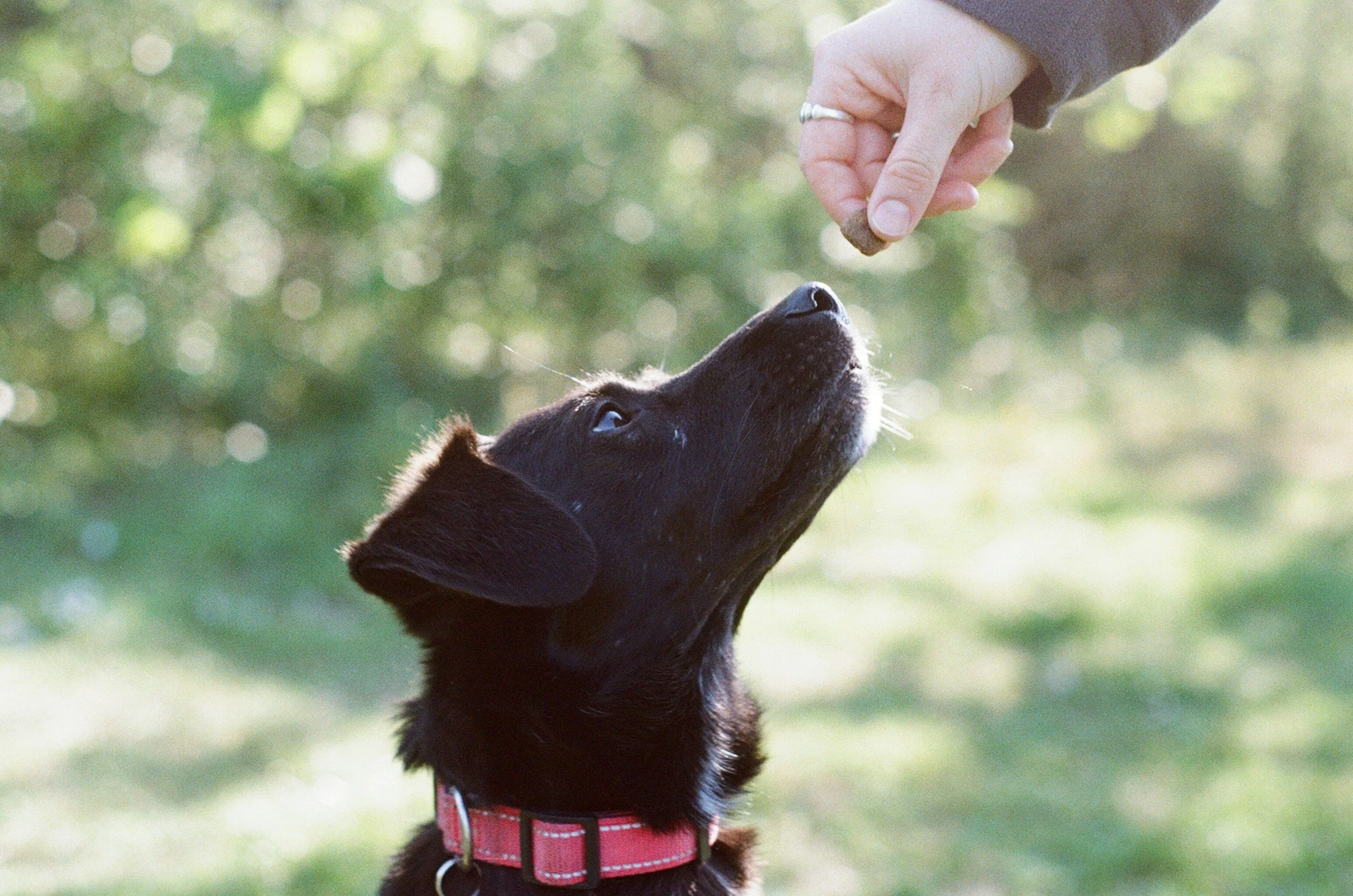
Place the low-value item in a closed hand and present it at a comfortable distance. Your dog may sniff, lick or investigate. Stay still and quiet. The moment they move their nose away, look elsewhere or pause their investigation, mark the choice with “yes” and give the better reward from your other hand.
Your closed hand prevents access without pushing the dog away. The dog discovers that disengaging makes the useful reward appear.
Repeat until your dog moves away quickly. If they scratch, bite at the hand or become increasingly excited, make the exercise easier and use a less interesting item.
Open the hand gradually
When your dog reliably backs away from the closed hand, open it slightly. Be ready to close it again if they move towards the food. Closing the hand is simple management, not punishment.
Mark and reward when the dog looks away. Gradually open the hand fully, keeping it high enough that you can protect the item. Your dog does not need to stare at you for a long time. A clear moment of disengagement is enough.
Avoid waving the food or repeatedly moving it towards the dog. You are teaching a calm choice, not trying to provoke a mistake.
Add the cue after the behaviour is predictable
Say “leave” once, immediately before presenting the easy item. When your dog disengages, mark and reward as before. The word gains meaning because it predicts a familiar action.
Do not repeat “leave, leave, leave” while the dog continues towards the item. Repetition teaches that the first cue is irrelevant. If the response does not happen, cover the item, create distance and return to an easier stage.
Move the item to the floor safely
Place one piece of low-value food on the floor and cover it with your foot, leaving enough space to prevent the dog reaching underneath. Give the cue once. Mark any movement away and deliver the better reward from your hand.
As the skill improves, uncover the item while remaining close enough to protect it. Pick it up after each repetition; do not release the dog to eat the “leave” item. Rewarding from you creates a clear pattern and reduces uncertainty about whether “leave” sometimes means “wait and grab it”.
Change only one thing at a time: distance, visibility, movement or value.
Add gentle movement
Real dropped food moves, so introduce that element carefully. Place the item down from a very low height, then reward the dog for leaving it. Later, roll a piece of kibble a short distance while the dog is on lead and you can block access.
Fast movement can be far more exciting than a stationary item. If your dog dives towards it, return to a smaller movement. The aim is not to test self-control until it fails; it is to build a response the dog can repeat.
Practise in new places
Dogs do not automatically transfer learning from the kitchen to the pavement. Practise in another room, the garden and a quiet outdoor area before expecting the cue to work on a busy walk.
Use a lead and sufficient distance from the training item. Begin with something boring and visible. Reward generously for turning away, then move on rather than circling back repeatedly.
Outside, environmental smells, stress and excitement can reduce your dog’s ability to respond. A slower response does not mean stubbornness; it means the situation is harder.
Use management on real walks
Training reduces risk, but it cannot make every pavement safe. Scan ahead, shorten the lead without jerking when you see food and cross the road or create distance when necessary. A well-fitted harness can support safe handling.
In areas with frequent food waste, a properly introduced basket muzzle may offer additional protection for some dogs. It must allow panting and drinking and should be introduced positively. Seek qualified help to choose and condition one rather than using it as a last-minute restraint.
Do not turn food into a battle
Chasing, grabbing collars or forcing a dog’s mouth open can increase swallowing, avoidance or guarding. Practise fair trades separately so you have a plan if your dog picks something up.
If your dog freezes, growls or guards found items, stop rehearsing the situation and seek help from an appropriately qualified reward-based professional. Guarding involves safety and emotion, not simply obedience.
Know when veterinary help is needed
If your dog eats a suspected toxin, medication, sharp object or unknown substance, contact your vet urgently. Do not wait for symptoms or induce vomiting unless a veterinary professional tells you to do so.
Build a response worth using
A strong leave cue works because the dog has a history of safe, well-rewarded choices. Continue to reward it in real life, especially when the item is difficult. Sometimes the reward can be moving forward, sniffing elsewhere or accessing a safe alternative.
For kind, practical help with leave, drop and everyday walking skills in Richmond, Teddington and nearby areas, I offer one-to-one training in the places where the behaviour actually happens.
Ready to take the next step?
If you're looking for friendly, reward-based dog training in Teddington, Twickenham, Richmond, Hampton, Kingston and the surrounding areas, I'd love to help or UK wide online.
Get in touch to discuss how we can build a happier, more confident relationship with your dog.
Choosing equipment
If you’re looking for leads, harnesses, calming products or anything else. Take a look at this page here where I’ve collated items for you.