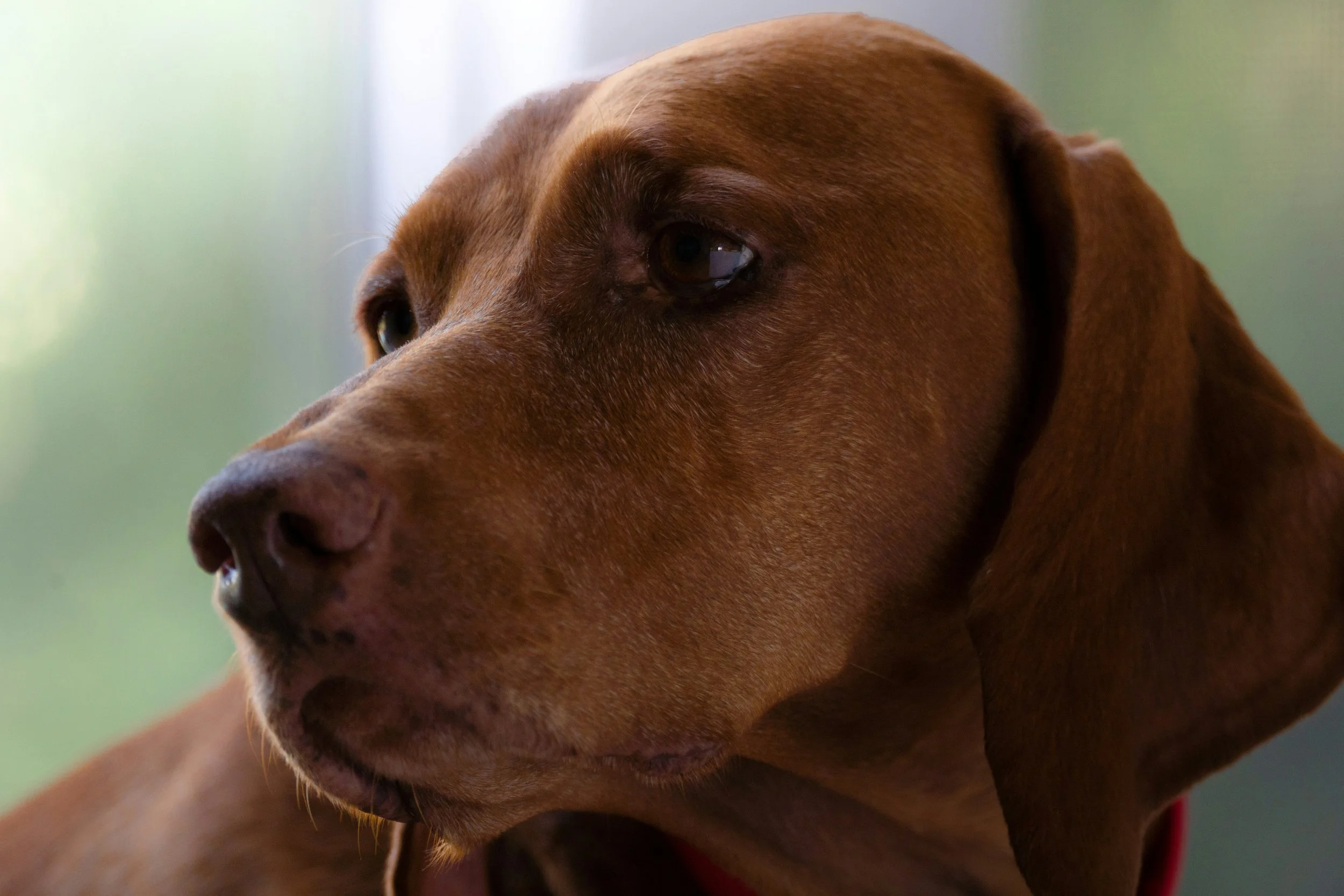
Dogs rarely move from completely relaxed to a large reaction without anything changing first.
Many use smaller signals to reduce pressure, avoid conflict or ask for distance. Those signals can be easy to miss when we are concentrating on the lead, talking to another person or hoping an interaction will go well.
Learning to notice when your dog needs more space is not about attaching one fixed meaning to every movement. It is about looking at the whole dog, the situation and what changes when the pressure is reduced.
Begin with your dog's relaxed baseline
Body language is easier to read when you know what your dog looks like in ordinary, comfortable moments. Notice their usual ear position, tail carriage, facial expression, pace and breathing when they are resting at home or walking somewhere familiar.
Different breeds and individual dogs naturally look different. A curled tail cannot hang loosely in the same way as a straight one, and ears shaped by breed may not move very far. Your most useful comparison is often your dog now against your dog a few minutes earlier.
Read the whole dog, not one feature
A wagging tail does not automatically mean a dog wants closer contact. The speed and height of the tail, the rest of the body and the context all matter. A loose dog with soft movement is different from a dog whose tail is moving while their body is stiff and their weight is shifted away.
Look at several features together: eyes, mouth, ears, tail, weight distribution and ability to move normally. Also notice whether the dog can sniff, take food gently and turn their attention away. One sign in isolation may mean little; a cluster or sudden change deserves attention.
Notice the quieter requests for distance
Early signs of discomfort may include turning the head away, looking away, lip licking when food is not present, yawning, lifting a paw, lowering the body, moving slowly or trying to position themselves behind you. Some dogs become unusually busy and sniff the ground; others stop moving.
These behaviours do not prove fear on their own. A dog can yawn because they are tired and lick their lips after eating. Context is the clue. If the behaviour begins when a stranger leans over them, another dog approaches or a child hugs them, treat it as useful information and create room.
Take stillness seriously
A dog who becomes very still may be under more pressure than a dog who is moving around. Freezing, a closed mouth, a hard stare, visible whites of the eyes, a forward weight shift or a tightly held body can indicate that the dog is struggling with what is happening.
Do not wait for a bark, lunge or snap before deciding the situation is too difficult. Calmly increase distance, ask people to stop approaching and give the dog a clear route away. A few metres can make a significant difference outdoors; at home, a gate, separate room or quiet resting place may be more appropriate.
Let moving away work
If your dog steps away from a person or another dog, do not repeatedly guide them back for another try. Moving away is a sensible way to prevent conflict. Allowing it to work teaches the dog that they can communicate without escalating.
Keep the lead as loose as safety allows and move in an arc rather than pulling directly towards the trigger. If someone wants to greet your dog, it is acceptable to say no. Your dog does not owe every person or dog an interaction.
Do not punish a growl
A growl is a warning that the dog is uncomfortable. It may be worrying to hear, but punishing it can suppress valuable information without changing the underlying emotion. The immediate response should be to stop the interaction, create distance and make everyone safe.
Once the pressure has passed, consider what led to the growl. Was the dog cornered, touched while resting, approached around food, surprised or already overwhelmed? Understanding the pattern helps you manage the next situation and decide whether professional support is needed.
Make greetings easier
Ask visitors to give the dog time rather than leaning over, reaching towards the head or insisting on touch. Let the dog choose whether to approach. A person can stand or sit slightly side-on, keep their hands to themselves and avoid staring.
Children need close adult supervision around dogs, even familiar ones. Give the dog a protected resting place and teach children that eating, sleeping and moving away mean the dog should be left alone. Management is not a failure; it prevents the dog being placed in situations they cannot manage.
Keep a simple record of patterns
If you are unsure what your dog is responding to, note the place, distance, people or dogs present, what happened immediately beforehand and how quickly your dog recovered. Short factual notes can reveal that difficulties are more likely in narrow spaces, at the end of a busy day or when several triggers appear together.
This information is also useful for a trainer or behaviour professional. Video can help when it is obtained safely, but never prolong a difficult situation simply to record it.
Consider health as well as training
Pain and illness can change how much handling, noise or social contact a dog can tolerate. A sudden change in behaviour, new sensitivity to touch, reluctance to move or unusual irritability should be discussed with your vet.
Behaviour support should work alongside appropriate veterinary care. Training cannot make discomfort irrelevant, and a dog who feels unwell may need a different plan.
Respond early and calmly
The best time to help is often when the signs are still small. Pause, add distance, reduce the number of demands and give the dog time to recover. When they can move freely, breathe normally and engage with the environment again, you have useful evidence that the situation has become easier.
The goal is not to expose a dog to everything until they stop reacting. It is to build safety, trust and skills at a level they can manage. If your dog regularly freezes, growls, lunges, hides or struggles to recover, seek help from an appropriately qualified, reward-based professional.
Ready to take the next step?
If you're looking for friendly, reward-based dog training in Teddington, Twickenham, Richmond, Hampton, Kingston and the surrounding areas, I'd love to help or UK wide online.
Get in touch to discuss how we can build a happier, more confident relationship with your dog.
Choosing equipment
If you’re looking for leads, harnesses, calming products or anything else. Take a look at this page here where I’ve collated items for you.